


Blog
Blinds Factory Inspection Points That Cut 40% of Export Quality Claims

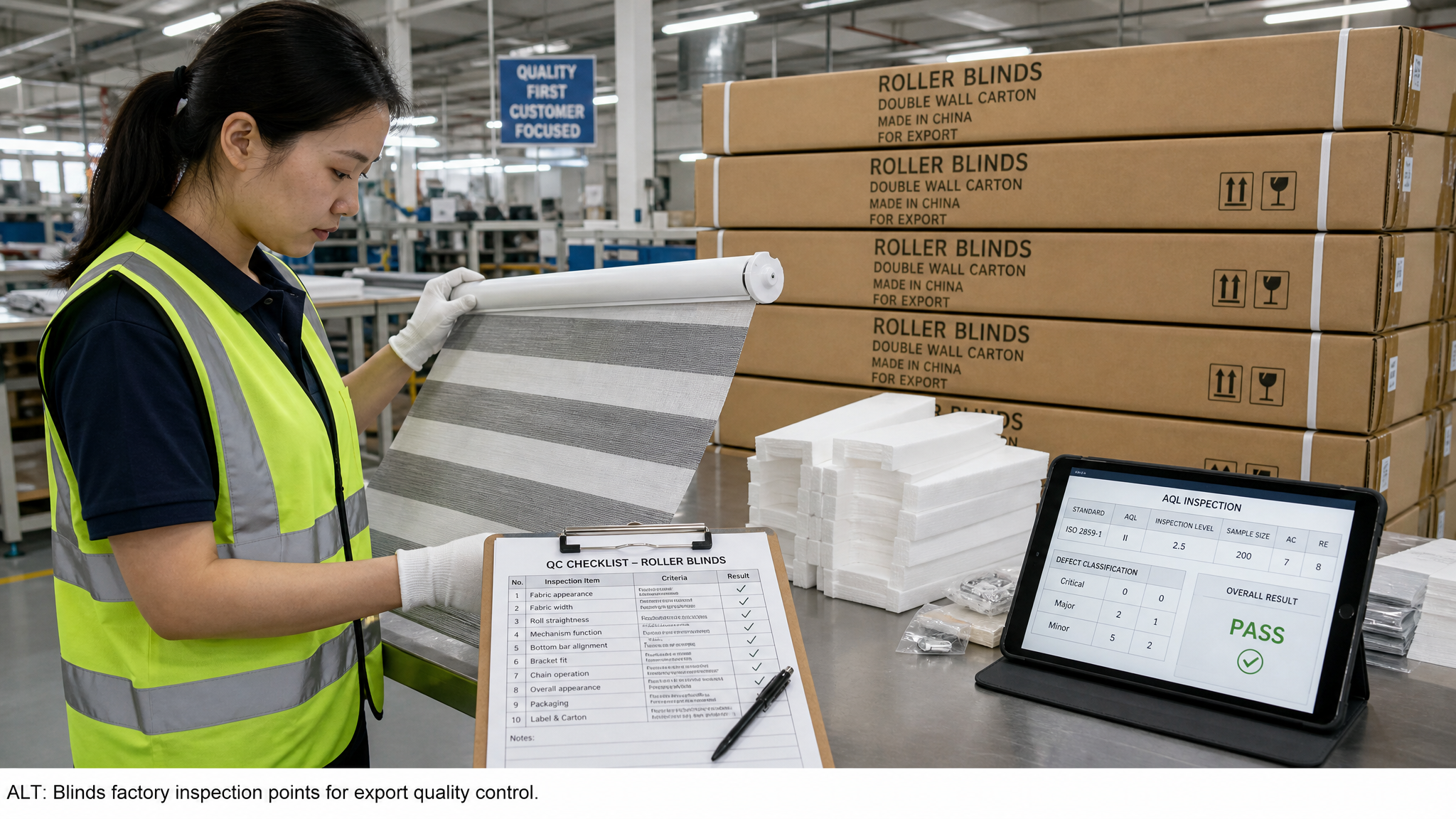
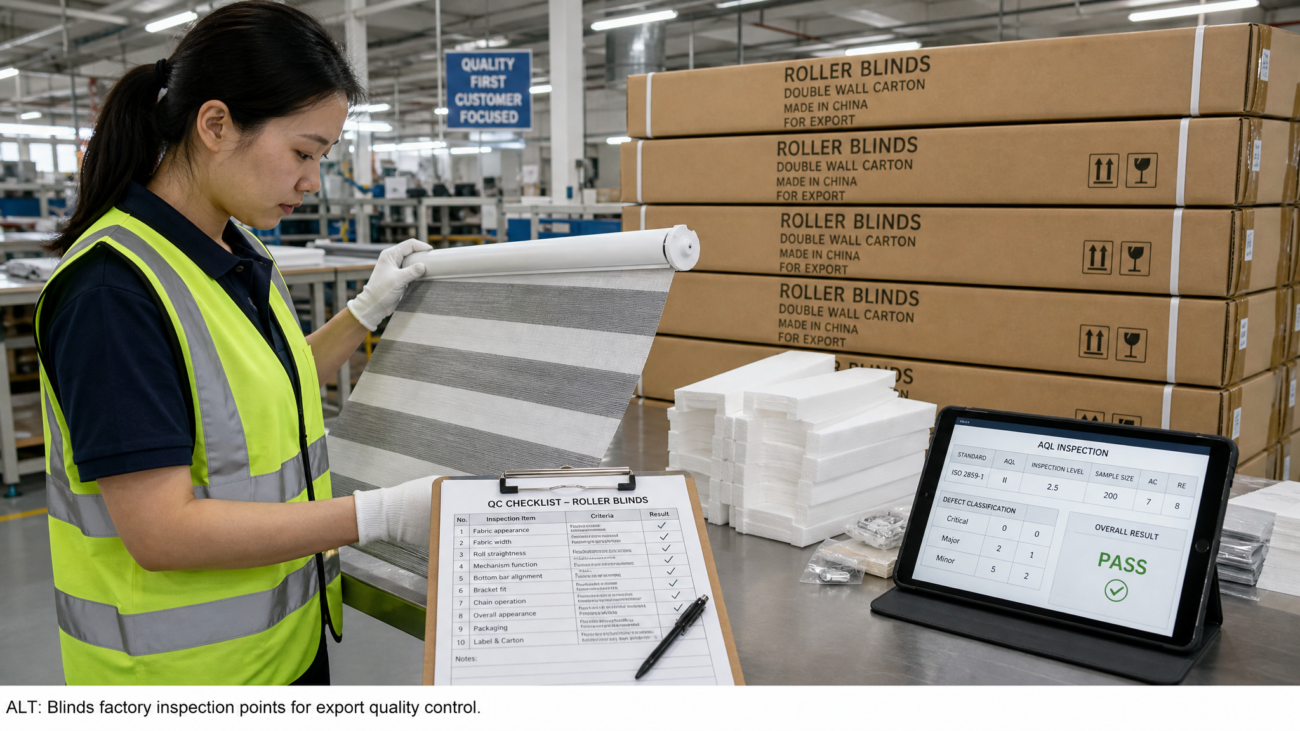
One rejected container of blinds can erase **$28,000** in profit through chargebacks, repackaging, and return freight. Yet many importers still rely on a final photo instead of a structured **blinds factory inspection**. The fix is not more emails—it is six **blinds factory inspection points** that catch defects before goods reach the port. Use these **blinds order quality control** gates to cut export quality claims by an estimated **40%** and keep your retail listings clean.
## Why Blinds Export Quality Claims Start at the Factory Gate
Blinds look simple, but they mix precision components: aluminum headrails, fabric or PVC slats, cord mechanisms, brackets, and child-safety hardware. A single tolerance drift in a bracket or slat coating can trigger an Amazon removal or a distributor chargeback.
Industry audits show that **60% of blinds export defects** are traceable to two sources: incoming raw materials and poor final packing. Reliable manufacturers typically split quality control into incoming, in-process, and final gates instead of doing one end-of-line check.
To avoid costly chargebacks, importers should treat a **blinds factory inspection** as a process, not an event. The six points below follow the same sequence a senior QC engineer would run on site.
## 6 Blinds Factory Inspection Points That Protect Your Order
Use these six **blinds factory inspection** gates to control quality from raw material to container loading.
### 1. Incoming Material Inspection: Stop Defects at the Source
A strong **blinds factory inspection** starts before cutting, with incoming material verification. The factory should verify every key input: aluminum alloy thickness, fabric or PVC slat color, cord tensile strength, and bracket plating.
Ask for a **material inspection report** against your approved spec sheet, not just a supplier certificate. Industry audits show that raw material issues cause roughly **35% of blinds rework** in low-cost factories.
Acceptable incoming QC usually follows **AQL 1.0–2.5** depending on the material and your tolerance for risk. Reject or quarantine any batch with color shift, sharp edges, or thickness below tolerance.
### 2. In-Process Random Sampling: Catch Semi-Finished Defects Early
In-process sampling is the second **blinds factory inspection** gate. It happens after key operations such as cutting, punching, coating, and cord threading.
Random sampling at **20–30% of WIP lots** helps catch systematic problems before they multiply. Ask the factory to record measurements for slat width, hole spacing, headrail straightness, and cord length on a **first-piece approval** form.
Reliable manufacturers typically keep these records for every production batch. If a sample fails on a major defect, the lot should be **100% reworked** before moving to the next station.
### 3. Final Outgoing Full Inspection: Gate Every Blind Before Packing
Final outgoing full inspection is the most visible **blinds factory inspection** point. It is the last chance to catch visual and functional issues before cartons are sealed.
A proper final QC gate checks each unit for smooth operation, cord retraction, tilt function, and visible marks or scratches. For bulk orders, use an **AQL 2.5 General Inspection Level II** sampling plan; for high-value or retail-critical orders, upgrade to **100% final inspection**.
The inspection must be performed under adequate lighting—usually **800–1,000 lux**—to spot surface defects. Record every defect by type and quantity, and stop packing if the defect rate exceeds the agreed AQL.
### 4. Third-Party Inspection Support: Independent Verification Without Travel
You do not need to fly to the factory to run a credible **blinds factory inspection**. Third-party inspection companies can perform pre-production, in-process, and pre-shipment checks using your QC checklist.
Send the inspector a sealed reference sample and a detailed spec sheet. Industry audits show that independent inspections catch **15–25% more major defects** than supplier self-checks alone.
Use third-party reports as evidence in chargeback disputes. A dated report with photos and AQL results is hard for a supplier to dismiss.
### 5. Ocean Freight Packaging Checks: Prevent Transit Damage
Packaging checks are often missing from a basic **blinds factory inspection**, but they determine whether the product arrives intact. Blinds are long, lightweight, and easily bent or crushed during ocean freight.
Specify a **double-wall export carton**, corner protectors, and inner dividers for aluminum or wood blinds. For high-value motorized blinds, add a waterproof poly bag or moisture barrier inside each carton.
Ask the factory to perform a **drop test** and a **stacking test** on at least one carton per lot. Reliable manufacturers typically document carton dimensions, weight, and pallet height in the pre-shipment report.
### 6. Full Accessory Kit Verification: Eliminate Missing-Part Complaints
Accessory verification is the final **blinds factory inspection** step before carton sealing. Missing brackets, screws, valance clips, or wand handles are among the most common blinds order complaints.
A final kit check must verify every accessory against the packing list. Use a simple **kit checklist** with photos: brackets, screws, spacer blocks, child-safety devices, and instruction manual.
Count pieces by weight or by fixture to avoid human error. For large orders, require the factory to include **2–3% spare accessories** in each carton or master pack.
## How to Use a Blinds QC Checklist to Avoid Chargebacks
Convert the six points above into a one-page **blinds order quality control** checklist and attach it to your purchase order. Make the checklist part of the contract, not a separate suggestion.
Your checklist should include: material certificates, first-piece approval, AQL sampling plan, packaging test results, accessory kit count, and final photos of the loaded container. Each item needs a pass/fail owner and a date.
Use the same **blinds factory inspection** checklist across suppliers so you can compare quality data. Buyers who standardize this process typically reduce export claims by **30–40%** within two production cycles.
## Red Flags to Avoid When Choosing a Blinds Factory
Watch for factories that refuse third-party inspection, cannot provide material traceability, or quote packaging without a test standard. These are early signs that your **blinds order quality control** will fail at the port.
Other red flags include: no written QC procedure, no first-piece approval, and a final inspection that is done by the production worker who built the unit. Segregation of duties matters.
Reliable manufacturers typically welcome a structured **blinds factory inspection** and share QC data proactively. If a supplier pushes back on AQL sampling or sealed reference samples, negotiate harder or switch suppliers.
## Conclusion: Your Blinds Order Quality Control Action Plan
Quality problems in blinds export are rarely random. They follow gaps in incoming material checks, in-process sampling, final inspection, packaging, and accessory verification.
Apply the six **blinds factory inspection points** above to cut chargebacks, protect margins, and keep your retail accounts clean. The key takeaways:
– Inspect materials before cutting, not after assembly.
– Run in-process and final AQL sampling with documented pass/fail limits.
– Verify packaging and accessory kits before every container is sealed.
CTA: Use this **blinds factory inspection** checklist to audit your current supplier’s next shipment. If the factory cannot pass these six gates, you are not buying blinds—you are buying chargebacks.
—
## 📚 Related Resources
– Anchor: Blinds supplier audit checklist — URL: /blinds-supplier-audit-checklist
– Anchor: Window blinds packaging standards for export — URL: /blinds-export-packaging-standards
– Anchor: AQL sampling guide for home goods importers — URL: /aql-sampling-guide-home-goods
– Anchor: Third-party inspection services for blinds — URL: /blinds-third-party-inspection
—
## ❓ Frequently Asked Questions
**Q: What is the standard AQL for blinds factory inspection?**
**A:** Most importers use AQL 2.5 General Inspection Level II for major defects and AQL 4.0 for minor defects. For high-value motorized blinds or retail-critical orders, upgrade to 100% final inspection or AQL 1.0–1.5.
**Q: How can I inspect blinds quality without traveling to the factory?**
**A:** Hire a third-party inspection company to perform pre-production, in-process, and pre-shipment checks. Send a sealed reference sample, detailed spec sheet, and your blinds QC checklist so the inspector can verify materials, workmanship, packaging, and accessories.
**Q: What packaging is best for exporting blinds by ocean freight?**
**A:** Use double-wall export cartons, corner protectors, and inner dividers for aluminum or wood blinds. Add a waterproof poly bag for motorized blinds, and require drop tests and stacking tests before loading.
**Q: What are the most common blinds order defects?**
**A:** Color shift, slat width deviation, headrail bending, cord mechanism failure, and missing accessories such as brackets and screws. These are best caught through incoming material inspection, in-process sampling, and final outgoing full inspection.
**Q: How do I avoid missing accessory complaints from customers?**
**A:** Verify every accessory against a photo-based kit checklist before sealing cartons, count pieces by weight or fixture, and include 2–3% spare accessories in each master pack.