


Blinds QC Gates That Stop $28K in Custom Order Rejections
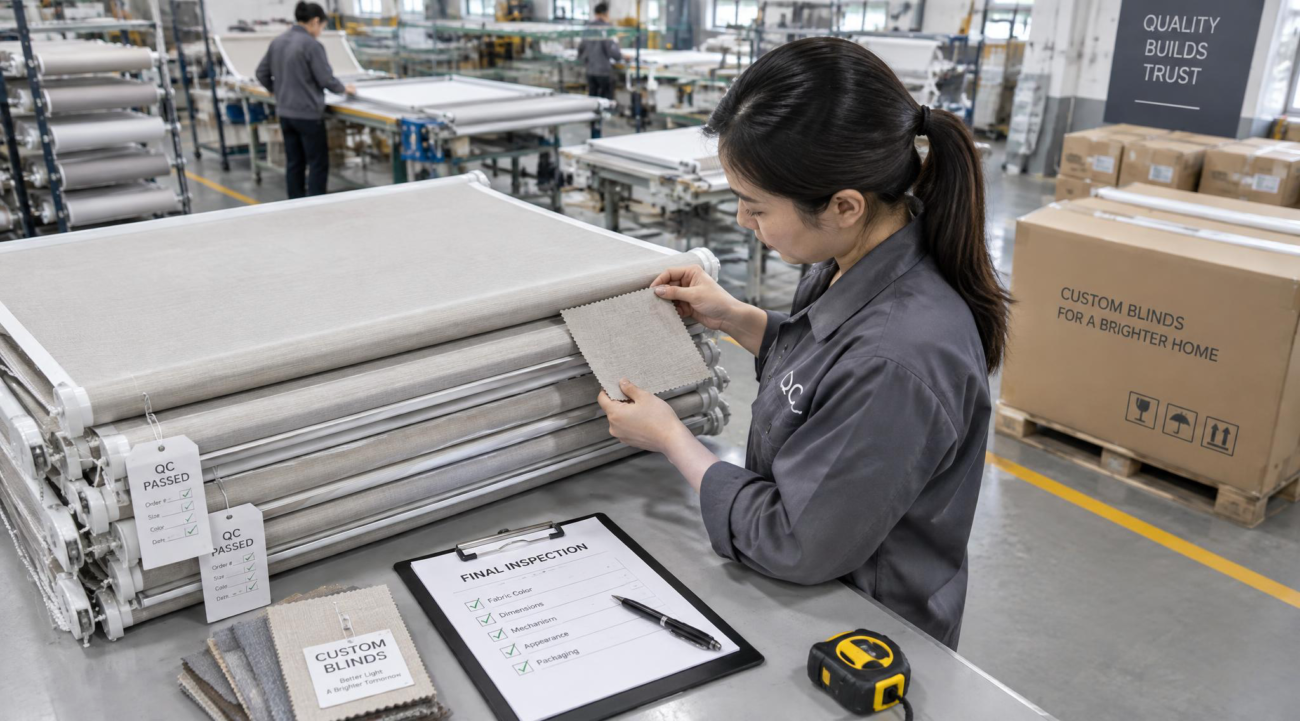
One rejected container of custom blinds can erase **$28,000** in margin — and that’s before rework, warehousing, and a burned retailer relationship. **Blinds order quality control** isn’t a cost center; it’s the only thing standing between a signed PO and a chargeback.
Industry audits show roughly **1 in 4** overseas blind shipments arrives with a defect serious enough to trigger a claim. This **curtain factory inspection** guide breaks down the six QC gates that separate reliable manufacturers from expensive gambles.
## Why Blind Orders Fail at Port: The Real Cost of Skipping QC
Most blind orders don’t fail because the factory can’t sew or cut. They fail because no one caught the problem while it was still cheap to fix. Industry audits show the three most common root causes are **incoming material defects**, **uncontrolled assembly variance**, and **sea-freight damage**.
A rejected 40-foot container of custom blinds typically costs **$18,000–$35,000** in chargebacks, return freight, and rework. That number climbs fast when a retailer misses a seasonal window. Reliable manufacturers treat **quality control for blinds orders** as a sequence of gates — each designed to stop defects before they compound downstream.
That’s why serious importers build their **window blinds quality control** plan around gates, not final inspection alone. To avoid costly chargebacks, buyers should verify that every gate exists in writing — not just in a sales pitch.
## The 6 Quality Control Gates Every Reliable Blinds Factory Must Run
### Gate 1 — Incoming Material Inspection Before Cutting
The first failure point in any **blinds factory inspection** is raw material. A blind is only as straight as the slat and only as color-consistent as the fabric lot.
– Check **fabric, wood, and PVC lot numbers** against the approved swatch before cutting.
– Verify **slat thickness, straightness, and coating adhesion** on a sampled batch.
– Confirm **cord and mechanism components** match the specified tensile and cycle ratings.
Reliable manufacturers typically log every incoming batch with a material inspection report. If a factory can’t show you these records, assume the defect is already baked into the order.
### Gate 2 — Semi-Finished Product Sampling on the Line
Waiting until the container is packed is too late. Smart factories inspect **semi-finished blinds** at 20%, 50%, and 80% assembly as part of the **blinds QC process**.
– Use **AQL 2.5** for major defects and **AQL 4.0** for minor defects as the minimum bar.
– Run **first-piece approval** on every new size or color before mass production.
– Measure **width, drop, and squareness** against the order spec, not the sample on the wall.
This gate catches systematic drift — like a jig out of square — before it ruins an entire production run.
### Gate 3 — Pre-Shipment Full Inspection (出厂全检)
For high-value or retail-ready blind orders, a **100% blinds pre-shipment inspection** is the standard that eliminates port rejections.
– Cycle every operating mechanism **5–10 times** to catch sticking cords or slipping tilters.
– Check **color match, hem alignment, and valance fit** under consistent lighting.
– Verify **safety compliance** — cord stops, tension devices, and warning labels where required.
Reliable manufacturers typically photograph and tag every carton after final inspection. This is the final chance to catch a defect before it crosses the ocean — which is why it’s the non-negotiable core of **blinds order quality control**.
### Gate 4 — Third-Party Inspection Support
A factory that resists independent inspection is hiding something. The strongest **blinds order quality control** programs welcome third-party auditors.
– Support **SGS, Bureau Veritas, TÜV, or Intertek** inspections at no penalty.
– Provide the auditor with the **approved sample, QC checklist, and packaging spec** on arrival.
– Release goods **only after the third-party report** clears the agreed AQL.
Industry audits show that suppliers with routine third-party inspection have **roughly 60% fewer** major-defect claims than self-inspected suppliers. That statistic alone justifies the audit fee in any **window blinds quality control** budget.
### Gate 5 — Sea-Freight-Safe Packaging
The best blind in the world is worthless if it arrives crushed. Sea freight exposes cartons to **90%+ humidity, stacking pressure, and rough handling**. Packaging is the weakest link in many **blinds order quality control** plans because buyers focus on the product and forget the journey.
– Use **double-wall cartons with corner protectors** for long window blind boxes.
– Add **moisture barriers or desiccant packs** for wood and fabric blinds.
– Palletize and **stretch-wrap with edge boards** so cartons don’t shift inside the container.
Reliable manufacturers typically run a **drop test and vibration test** on packaged samples before bulk packing. If your supplier can’t describe their packaging standard, you’re about to pay for the lesson in freight claims.
### Gate 6 — Complete Accessory Kits
Missing brackets and screws are the most avoidable defect in the blinds trade. Complete accessory kits are a cornerstone of any **blinds QC process**, because a blind with no mounting hardware is a return, not a product.
– Build a **bill of materials per SKU**: brackets, screws, wand, valance clips, cord cleats, instructions.
– Pack accessories in a **sealed, labeled polybag** inside the main carton — never loose.
– Run a **carton weight check** on the line to catch kits that are missing components.
This gate costs almost nothing and prevents the single most common end-user complaint in blinds e-commerce.
## What Industry Audits Reveal About Blinds Order Quality Control
Audit data from blinds and window covering importers paints a clear picture. Roughly **40% of defects** are traceable to incoming material, **30% to assembly variance**, and **20% to packaging and transit**. Only **10%** come from random, isolated errors.
That distribution explains why a gated **curtain factory inspection** process works. Each gate targets a specific failure mode with a measurable pass/fail standard. The factories that run all six gates consistently ship at **below 1% major-defect rates** — the threshold most big-box retailers require for ongoing vendor status.
For B2B buyers, that number is the difference between a repeatable supply chain and a constant firefight.
## How to Audit a Blinds Supplier Before You Place the PO
You don’t need to fly to the factory to verify a **blinds order quality control** program. You need the right documents and the right questions.
– **Request 3 recent inspection reports** — incoming material, in-process, and final. Red flag: they can only produce one.
– **Ask for the packaging specification** with drop-test and moisture-control details in writing.
– **Confirm third-party access** — name the audit firm you plan to use and watch the response time.
– **Order a pre-production sample and a production sample** from the actual line, not the showroom.
Use this **custom blinds quality inspection** checklist to audit your current supplier before the next PO. If a gate is missing, negotiate it in — or find a factory that already runs it.
## Conclusion: Three Takeaways Before You Ship
1. **QC is a sequence, not a step.** Incoming material, in-process sampling, and final inspection each catch what the previous gate missed.
2. **Third-party verification is your cheapest insurance.** A few hundred dollars in audit fees beats a five-figure chargeback every time.
3. **Packaging and accessories are quality features.** Sea-freight-safe packing and complete hardware kits prevent the most common return triggers.
Download this **curtain factory inspection** checklist, send it to your supplier, and require a signed QC plan before you release the next deposit. Your margin — and your retailer relationships — depend on it.
—
## 📚 Related Resources
Custom Blinds MOQ Guide: How to Negotiate Minimum Order Quantities → /custom-blinds-moq-guide
Window Blinds Material Comparison: Fabric vs. Wood vs. PVC → /window-blinds-material-comparison
Sea Freight Packaging Standards for Window Coverings → /sea-freight-packaging-window-coverings
Third-Party Inspection Checklist for Blinds Importers → /third-party-blinds-inspection-checklist
—
## ❓ Frequently Asked Questions
**Q:** What is blinds order quality control?
**A:** Blinds order quality control is a gated inspection process that verifies incoming materials, in-process assembly, and finished goods against an agreed AQL standard before shipment. It also covers third-party inspection, packaging, and accessory completeness to prevent port rejections and chargebacks.
**Q:** What AQL level should I use for custom blinds inspection?
**A:** Most importers use AQL 2.5 for major defects and AQL 4.0 for minor defects. For retail-ready or high-value blind orders, many brands require 100% pre-shipment inspection on mechanisms and color match.
**Q:** How do I prevent sea-freight damage to window blinds?
**A:** Use double-wall cartons with corner protectors, add moisture barriers or desiccant packs, and palletize with stretch-wrap and edge boards. Reliable factories also run drop and vibration tests on packaged samples before bulk packing.
**Q:** Should I hire a third-party inspection company for blinds orders?
**A:** Yes. Third-party firms like SGS, Bureau Veritas, TÜV, and Intertek provide independent pass/fail reports. Industry data shows suppliers with routine third-party inspection have roughly 60% fewer major-defect claims.
**Q:** What accessories should be packed with custom blinds?
**A:** Every carton should include the correct brackets, screws, wand or cord control, valance clips, cord cleats, and installation instructions, sealed in a labeled polybag. A carton weight check on the line catches missing components before shipping.