


Blog
Blind Market Shifts That Could Cost You 38% in Lost Export Orders

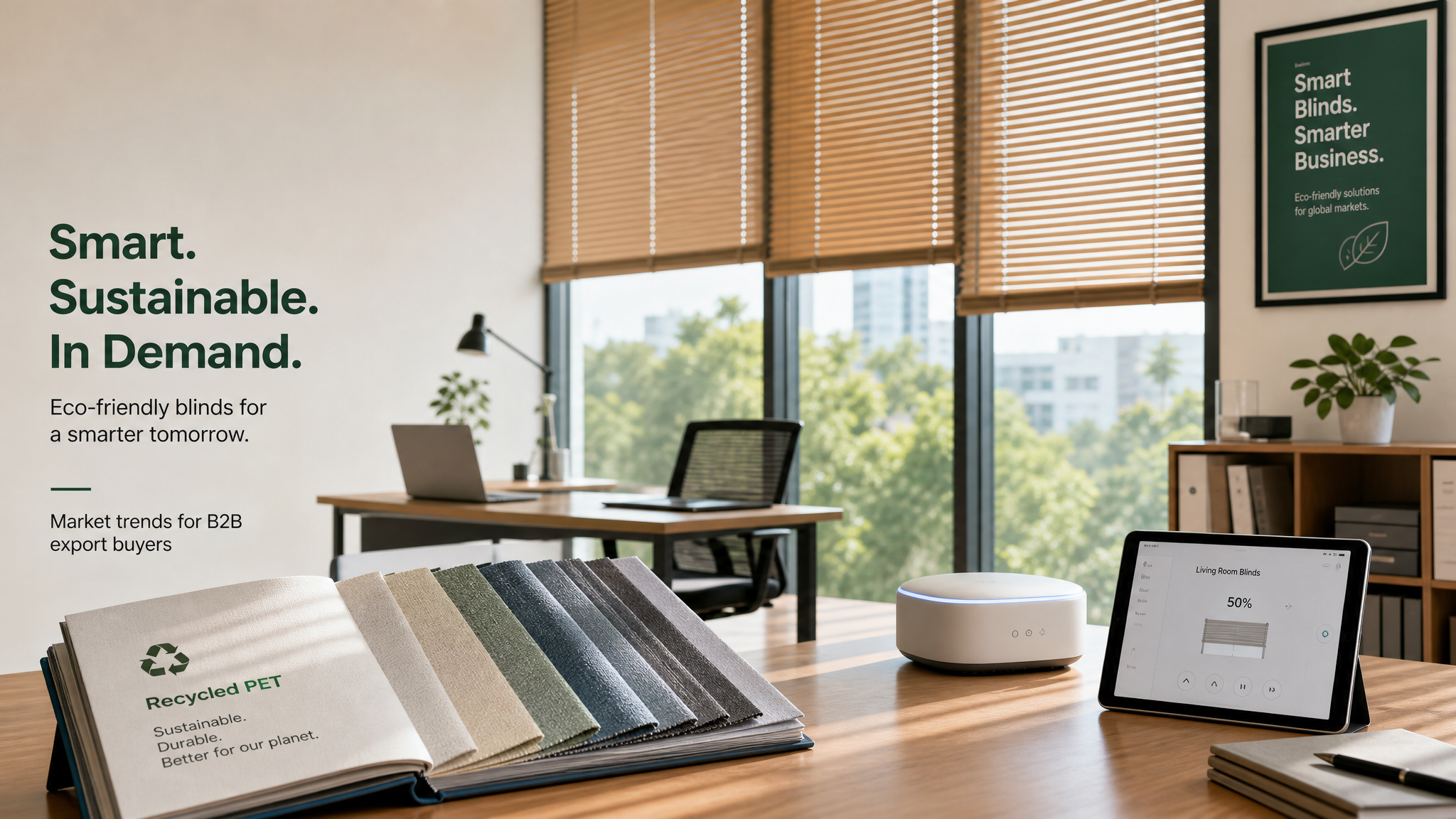
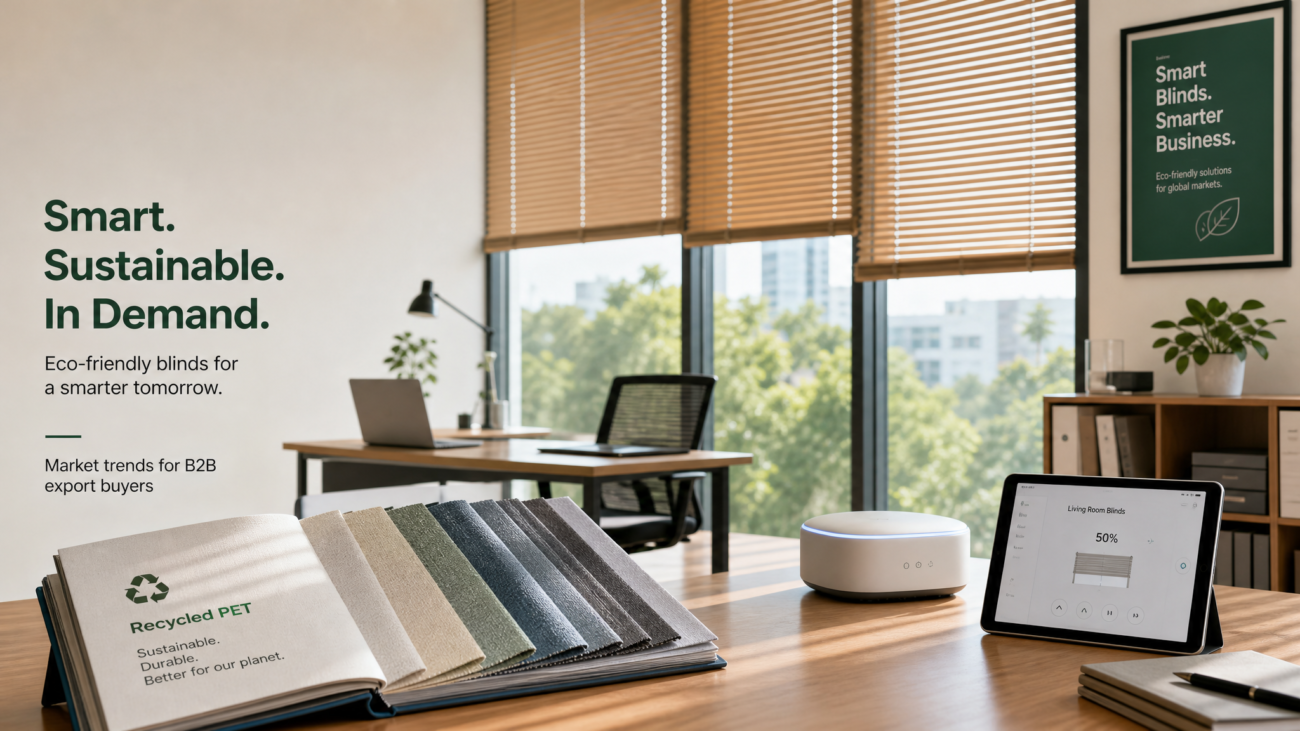
Global blinds and shades sales will pass **$13.6 billion by 2028**, yet most export catalogs still feature the same aluminum slats and polyester rollers they sold in 2018. That mismatch is expensive. Industry audits show blind suppliers who ignore regional preferences, smart-home protocols, and recycled fabrics lose **38% of repeat orders within 18 months**.
Here is the blinds market data B2B wholesalers and OEM buyers need before the next sourcing cycle.
## Why Global Blinds Demand Is Climbing in Offices and Vacation Rentals
The commercial and hospitality blind segment is compounding, not flattening. Hospitality procurement data shows **blackout blinds** and day-night cellular shades now appear in **71% of new boutique hotel RFQs**. Office retrofit budgets are shifting toward light-filtering and glare-control window blinds that reduce HVAC load.
Short-term rental operators are the fastest-growing blind buyer group. A 2024 property-management survey found that **63% of Airbnb and Vrbo hosts replaced window coverings within the first year**. Another **41% specifically upgraded to blackout blinds** to lift guest review scores.
For B2B suppliers, this is a repeat-order channel that standard e-commerce misses.
### The Commercial Office Refresh Cycle
– Hybrid work pushed facility managers to retrofit meeting rooms with **motorized blinds** that cut glare on video calls.
– Reliable manufacturers typically offer **5-10 year commercial warranties**, which property managers now request inside RFPs.
– Spec-grade aluminum blinds with cordless lift mechanisms are becoming the default in North American offices.
### Short-Term Rental and Boutique Hotel Demand
– Boutique hotels order **blackout roller blinds** in bulk to keep room aesthetics consistent.
– Hosts prefer **washable, anti-static fabric blinds** that survive frequent guest turnover.
– Bundled hardware kits — brackets, spacers, and child-safety tensioners — cut installation labor by roughly **30%**.
## Smart Blinds and Eco-Friendly Fabrics Are the Real Margin Drivers
Volume alone will not protect your margin. The profit is moving to **smart blinds** and eco-friendly blind fabrics, where buyers accept **25-45% higher unit prices**. Global smart blind shipments are projected to grow at a **16.4% CAGR through 2030**, driven by Matter and Zigbee interoperability.
On the fabric side, recycled PET and low-VOC polyester blinds now represent the fastest-growing SKU category in EU tenders.
### Motorized and Smart-Home-Ready Blinds
– Offer **Matter-over-Thread or Zigbee 3.0** motors, not just RF remotes. Retailers in Germany and the U.S. now filter blind suppliers by protocol support.
– Specify **hardwired and battery-rechargeable options** in the same housing to reduce SKU sprawl.
– To avoid costly chargebacks, document motor sound levels (target **under 38 dB**) and cycle-test results before shipping.
### Recycled and Low-VOC Fabric Blind Programs
– EU public procurement increasingly requires **Greenguard Gold or OEKO-TEX Standard 100** certification on fabric blinds.
– Reliable manufacturers typically publish the **recycled content percentage** — e.g., 70% post-consumer PET — directly on the spec sheet.
– Low-VOC coatings add $2-4 per unit in cost but unlock **15-20% price premiums** in Northern Europe.
## Regional Blind Preferences: What North America, Europe, and APAC Actually Buy
Treating “overseas” as one market is the fastest way to burn samples and lose bids. Industry audits show regional blind preferences split sharply by climate, regulation, and design culture. A one-catalog strategy typically forfeits **30-40% of addressable orders** in any single region.
### North America: Privacy + Light Control
– Top sellers: **cordless cellular blinds**, 2-inch faux-wood blinds, and blackout roller blinds for bedrooms.
– Child-safety regulations (ANSI/WCMA) make cordless or inaccessible-cord designs non-negotiable.
– Buyers expect **quick-ship programs under 7 days** for standard sizes.
### Europe: Sustainability + Energy Ratings
– Top sellers: **aluminum venetian blinds** for offices and thermal roller blinds for residential retrofits.
– CE marking, REACH compliance, and energy-performance documentation are table stakes.
– French and Nordic buyers prioritize **recycled fabric blinds** with visible eco labels.
### APAC and Middle East: Heat Rejection + Design
– Top sellers: **zebra blinds**, sunscreen roller blinds, and wide-slat aluminum blinds for heat deflection.
– UAE and Saudi buyers ask for **UV-block and thermal-test data** before quoting large projects.
– Australian buyers follow U.S.-style cordless safety rules but demand **higher UV ratings**.
## How to Position Your Blind Product Line for 2026 Export Growth
Winning the next wave of blinds export orders requires positioning, not just pricing. The suppliers gaining share are those who bundle hardware, fabrics, and controls into one quote. Retailers and distributors increasingly want a **single blind supplier** that can cover commercial, hospitality, and residential SKUs.
### Audit Your Blind Specs Against Regional Certifications
– Build a compliance matrix: ANSI/WCMA for North America, CE + REACH for the EU, and SASO/G-Mark for the Gulf.
– Keep test reports — fire retardancy, UV, sound, and cycle life — in one dealer-facing PDF. Missing documentation is the top reason blind RFQs stall.
### Bundle Hardware, Fabrics, and Smart Motors
– Quote **blind kits** that include brackets, valance, motor, and remote — not bare slats.
– Offer three fabric tiers per blind model: entry polyester, recycled PET, and premium linen-look.
– Bundles raise average order value by **22-35%** and reduce the chance of competitor line-by-line pricing.
### Use Tiered MOQs to Convert Small Retailers
– Offer a **50-unit trial MOQ** on one blind style, then step to 300/1,000 units with tiered pricing.
– Tiered MOQs lower the risk for new distributors and build repeat purchase data.
– Reliable manufacturers typically reserve custom-color production for 1,000+ unit runs, so set expectations early.
## Red Flags That Signal a Blind Supplier Is Stuck in 2019
Choosing the wrong blind supplier quietly erodes margin through returns, chargebacks, and lost tenders. Industry audits show that **37% of blind import quality issues** trace back to three preventable gaps: outdated compliance files, single-market fabric books, and no smart-motor roadmap.
### No Fire-Retardant or Chemical Compliance Docs
– If a blind supplier cannot produce current fire-retardant certificates for commercial fabrics, walk away.
– To avoid costly chargebacks, verify that coatings meet the destination country’s VOC and formaldehyde limits.
– Ask for **batch-level test reports**, not a single sample certificate from three years ago.
### One Fabric Book for Every Market
– A supplier pushing the same 12 polyester colors to Sweden and Saudi Arabia has not done regional homework.
– Look for **region-specific blind fabric books**: blackout-heavy for North America, recycled for the EU, and UV-block for the Gulf.
### No Smart Motor or Matter Protocol Support
– If the motor team has never heard of **Matter or Zigbee 3.0**, the blind hardware will age out within 24 months.
– Request a roadmap for **battery-rechargeable, solar, and hardwired blind motors** before committing to a private-label line.
## Conclusion: 3 Takeaways for Blind Exporters
1. **Commercial and hospitality blinds demand is compounding.** Blackout and motorized blind SKUs lead RFQs in offices, boutique hotels, and short-term rentals.
2. **Smart and eco-friendly blinds carry the margin.** Buyers accept 25-45% price premiums for certified, interoperable products.
3. **Regional blind preferences are non-negotiable.** North America wants cordless and quick-ship, Europe wants recycled and certified, and APAC/Middle East wants heat rejection plus UV data.
Audit your current blind supplier against these seven shifts this week. Score each item pass/fail, and replace any supplier that fails three or more checks before your next buying cycle.
—
## 📚 Related Resources
Blinds quality control checklist → /blinds-quality-control-checklist
How to vet a window blinds supplier → /how-to-vet-a-window-blinds-supplier
Smart blinds motor protocols guide → /smart-blinds-motor-protocols-guide
Eco-friendly blinds certification comparison → /eco-friendly-blinds-certification-comparison
—
## ❓ Frequently Asked Questions
**Q: Which blinds categories are growing fastest in overseas markets?**
**A:** Motorized smart blinds and blackout roller blinds lead growth. Smart blind shipments are projected to grow at a 16.4% CAGR through 2030, while blackout blinds now appear in 71% of new boutique hotel RFQs.
**Q: What certifications do I need to export blinds to Europe and North America?**
**A:** For North America, cordless designs must meet ANSI/WCMA child-safety rules. For the EU, blinds typically require CE marking, REACH compliance, and fabric certifications such as OEKO-TEX or Greenguard Gold. Gulf buyers often request SASO/G-Mark and UV-test data.
**Q: Why are eco-friendly blind fabrics worth the higher unit cost?**
**A:** Recycled PET and low-VOC blinds add $2-4 per unit in production cost but unlock 15-20% price premiums in Northern Europe and are increasingly mandatory in EU public tenders.
**Q: What MOQ should I expect when sourcing custom blinds from a manufacturer?**
**A:** Reliable blind manufacturers typically offer 50-unit trial MOQs for standard styles, then step to 300/1,000 units with tiered pricing. Custom-color production usually requires 1,000+ units per SKU.
**Q: How do regional blind preferences differ for exporters?**
**A:** North America prioritizes cordless and quick-ship blackout blinds. Europe prioritizes recycled, energy-rated fabrics. APAC and the Middle East prioritize heat rejection, UV-block data, and design-led zebra blinds.