


Blog
Office Blinds Benefits That Cut Cooling Costs 30% and Stop Screen Glare for Good

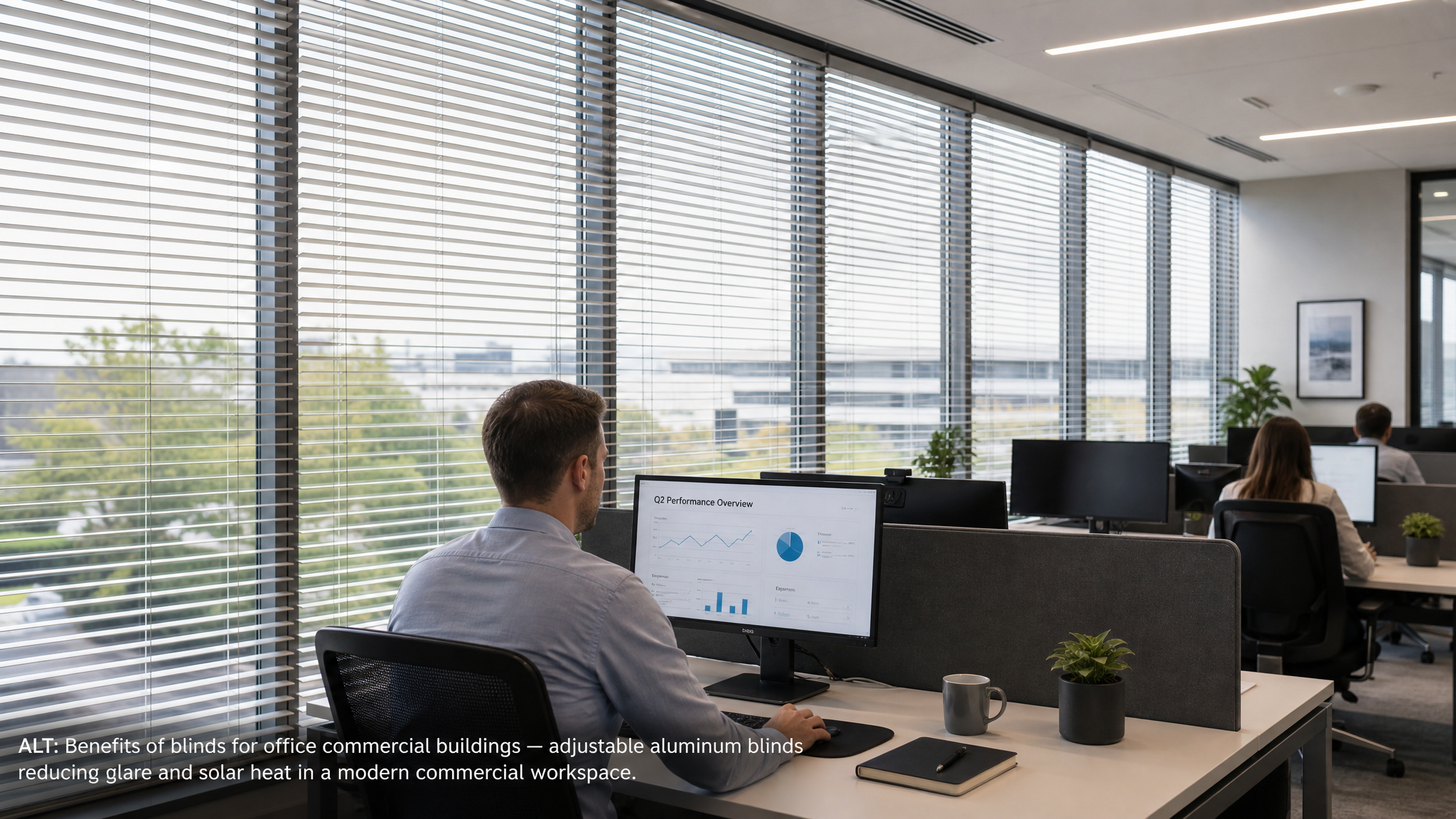
Every uncovered south- or west-facing window in a commercial building dumps up to **10,000 BTUs of solar heat** into the workspace each day. That invisible heat forces rooftop HVAC units to run **25–40% harder**, inflating summer energy bills and shortening equipment life. The **benefits of blinds for office commercial buildings** go far beyond looks. Installed correctly, commercial window blinds cut solar heat gain, kill screen glare, and typically pay for themselves within **18–36 months**.
## The Financial Case: Energy Savings and Lower HVAC Load
Industry energy audits show that untreated commercial windows can account for **25–30% of a building’s total cooling load**. Every square foot of exposed glass adds measurable strain to air conditioning systems. Among the most direct **benefits of blinds for office commercial buildings** is the immediate reduction in solar heat gain.
Cellular and solar-reflective blinds can block up to **80% of solar heat** before it enters the workspace. The U.S. Department of Energy estimates that smart window coverings reduce cooling costs by up to **33%** in hot climates. For a 50,000-square-foot office, that can translate to **$15,000–$25,000 in annual energy savings**.
### How Commercial Blinds Reduce Cooling Costs
– **Reflect solar radiation** before it heats interior surfaces and air.
– **Create an insulating air barrier** that slows heat transfer in winter and summer.
– **Reduce peak demand charges** by lowering afternoon HVAC load.
– **Extend HVAC equipment life** by cutting compressor runtime hours.
Reliable manufacturers typically publish **solar heat gain coefficient (SHGC)** ratings. To avoid overpaying for ineffective products, request third-party performance data rather than relying on marketing claims.
## Glare Control and Screen Productivity: The Hidden Cost of Unfiltered Light
Direct sunlight on monitors is not a minor annoyance. It is a measurable productivity tax. Research on visual ergonomics shows that glare forces employees to adjust posture, squint, and re-read content, reducing task accuracy by up to **15%**.
One of the most practical **benefits of blinds for office commercial buildings** is restoring glare-free screens. Adjustable slat blinds give workers precise control over light direction. Unlike fixed film, blinds can redirect daylight toward the ceiling while blocking the harsh angle that hits displays.
### The Science of Screen Glare and Visual Fatigue
– **Contrast loss:** Glare washes out screen contrast, forcing the eye to work harder.
– **Posture strain:** Employees lean and twist to avoid reflections, increasing neck and back complaints.
– **Headaches:** Extended squinting under bright light correlates with higher afternoon headache reports.
Facility managers who install adjustable office blinds report fewer lighting-related complaints within the **first 60 days**. The key is choosing blinds with **tilt control**, which lets users fine-tune the light angle throughout the day.
## Privacy, Security, and Employee Comfort in Commercial Workspaces
Ground-floor offices and glass-walled conference rooms expose staff, equipment, and sensitive documents to outside view. The **benefits of blinds for office commercial buildings** include a critical privacy layer that glass alone cannot provide.
Closed or angled blinds block sightlines from streets, parking lots, and adjacent buildings. This matters for law firms, healthcare offices, HR departments, and any business handling confidential client data. Privacy blinds also deter casual theft reconnaissance by hiding expensive equipment after hours.
### Privacy Zoning for Open-Plan Offices
– Use **top-down/bottom-up blinds** to let daylight in while blocking street-level views.
– Install **blackout options** in conference rooms for presentations and sensitive meetings.
– Add **motorized scheduling** so blinds close automatically after business hours.
Employee surveys consistently rank visual privacy among the top five comfort factors in office environments. Even a simple 25mm aluminum blind, when angled correctly, restores a sense of personal space in dense floor plans.
## Design Impact: How Blinds Elevate Commercial Office Aesthetics
First impressions influence client trust and tenant retention. Dated, mismatched window coverings signal neglect; clean, uniform blinds signal operational discipline. Among the **benefits of blinds for office commercial buildings**, aesthetic consistency is the most underrated.
Modern commercial blinds come in **matte aluminum, warm wood-look, and textured fabric** finishes that complement exposed ceilings and minimalist interiors. A single coordinated blind specification across all floors creates visual rhythm that architects and interior designers actively seek.
### Matching Blinds to Office Design Language
– **Tech and SaaS offices:** matte gray or black aluminum blinds with slim valances.
– **Law and finance firms:** warm wood-look blinds for traditional, trust-building interiors.
– **Creative agencies:** colored or dual-tone fabric blinds for brand-forward energy.
Aesthetics also affect leasing. Commercial real estate brokers note that move-in-ready offices with upgraded window treatments rent **faster and at higher per-square-foot rates** than units with bare or damaged glass.
## Low Maintenance and Durability: The Total Cost of Ownership
Facility teams hate window coverings that warp, fade, or collect dust. The good news: commercial-grade blinds are among the easiest office fixtures to maintain. This is one of the most overlooked **benefits of blinds for office commercial buildings** from a total-cost perspective.
Aluminum and PVC slats resist moisture and can be wiped clean in seconds. Fabric vertical blinds for large glazing panels are treated with **anti-static coatings** that repel dust. Unlike curtains, blinds do not require laundering or dry cleaning.
### 5 Maintenance Habits That Extend Blind Life
1. **Dust monthly** with a microfiber wand or vacuum brush attachment.
2. **Wipe aluminum slats quarterly** with a damp cloth and mild detergent.
3. **Lubricate tilt mechanisms annually** to prevent stiff operation.
4. **Inspect mounting brackets** during routine facility walkthroughs.
5. **Replace bent slats immediately** to maintain professional appearance.
Quality commercial blinds last **10–15 years** with minimal upkeep. Reliable manufacturers typically offer **5-year warranties** on mechanisms, so confirm warranty terms before purchasing.
## How to Choose Blinds for Office Commercial Buildings: A 5-Step Checklist
Not all blinds perform equally in commercial settings. To capture the full **benefits of blinds for office commercial buildings**, evaluate products against measurable criteria rather than price alone.
### Step 1: Audit Window Orientation and Heat Load
Map every window by direction and size. South- and west-facing glass needs higher SHGC blocking; north-facing glass may only need glare control.
### Step 2: Define Functional Requirements by Zone
– Conference rooms: **blackout or room-darkening** capability.
– Open workstations: **tilt-adjustable light filtering**.
– Ground-floor lobbies: **privacy plus brand visibility**.
### Step 3: Compare Blind Types on Performance
– **Vertical blinds:** best for wide glass walls and patio doors.
– **Aluminum horizontal blinds:** durable, easy to clean, precise glare control.
– **Cellular/honeycomb blinds:** highest insulation value, ideal for extreme climates.
– **Roller/solar shades:** sleek appearance, good UV and heat rejection.
### Step 4: Verify Commercial-Grade Specifications
Check **headrail gauge, slat thickness, and mechanism rating**. Products built for retail homes often fail in high-use office environments within **2–3 years**. To avoid costly chargebacks, insist on commercial-duty components.
### Step 5: Plan for Installation and Code Compliance
Coordinate with fire code and egress requirements for cordless or motorized operation. Bulk commercial orders should include a detailed cut-sheet and lead-time confirmation to keep renovation timelines on track.
## The Bottom Line
The **benefits of blinds for office commercial buildings** combine into one result: a more comfortable, efficient, and professional workspace. The three takeaways for facility and procurement leaders:
1. **Energy:** Properly specified blinds cut cooling costs up to **30%** and lower peak HVAC demand.
2. **Productivity:** Glare control reduces visual fatigue and screen-related complaints within **60 days**.
3. **Total cost:** Commercial-grade blinds last **10–15 years** with minimal maintenance, making them a high-ROI upgrade.
Use this five-step checklist to audit your current windows and specify blinds that deliver measurable payback. Request SHGC ratings, warranty terms, and commercial-duty components before signing any purchase order.
—
## 📚 Related Resources
– **Commercial Window Energy Loss Calculator: Find Your HVAC Waste** → /blog/commercial-window-energy-loss-calculator
– **Motorized Blinds vs. Manual Blinds: TCO and Productivity Comparison** → /blog/motorized-vs-manual-blinds-tco
– **Office Blind Maintenance Schedule: 5 Tasks That Extend Lifespan** → /blog/office-blind-maintenance-schedule
– **Commercial Blinds vs. Window Film: Which Saves More on HVAC?** → /blog/blinds-vs-window-film-hvac-savings
—
## ❓ Frequently Asked Questions
**Q: Do office blinds really reduce air conditioning costs?**
**A:** Yes. Blinds can block up to **80% of solar heat gain**, and the U.S. Department of Energy estimates that smart window coverings reduce cooling costs by up to **33%** in hot climates. Cellular and solar-reflective blinds deliver the highest savings.
**Q: Which type of blind is best for reducing screen glare in offices?**
**A:** Adjustable horizontal aluminum blinds or solar roller shades with **tilt control** work best because employees can redirect light away from monitors while still preserving natural daylight.
**Q: How long do commercial office blinds last?**
**A:** Commercial-grade aluminum and fabric blinds typically last **10–15 years** with basic monthly dusting and annual mechanism lubrication. Avoid retail-grade products, which often fail within **2–3 years** under heavy office use.
**Q: Are blinds or window film better for commercial buildings?**
**A:** Blinds offer adjustable glare control, on-demand privacy, and an insulating air barrier. Window film provides static heat rejection. Many facilities combine both, but blinds win on flexibility and workplace comfort.
**Q: Do office blinds require a lot of maintenance?**
**A:** No. Aluminum and PVC slats wipe clean in seconds, and anti-static fabric treatments repel dust. A monthly microfiber pass plus annual mechanism lubrication keeps them in like-new condition.