

Blog
Blinds Supplier Red Flags That Add 23% to Overseas Contractor Procurement Costs



Industry audits show that **61% of overseas contractors** who switch blinds suppliers mid-project lose at least **23%** in rework, expedited freight, and downtime. Blinds procurement for overseas contractors is not a simple price comparison—it is a risk-management decision disguised as a purchase order. One missing fire certificate or an unstable delivery window can stall a 200-room hotel fit-out for weeks. This is why mature procurement teams treat blinds procurement as a compliance and logistics workflow, not a commodity buy.
## How Overseas Contractors Actually Source Blinds: Procurement Habits That Shape Supplier Selection
Overseas engineering contractors rarely buy blinds on impulse. Their blinds procurement process follows a qualification sequence: **certificates first, samples second, delivery stability third, and price last**. In blinds procurement, price is the last gate, not the first filter. A procurement error in blinds creates downstream costs in electrical, HVAC, and interior finishing.
Key habits that shape commercial blinds sourcing include:
– **Certificate-first qualification.** Reliable manufacturers typically provide fire-rated test reports, ISO 9001, and regional compliance documents before pricing.
– **Physical sample validation.** Contractors request production samples—not showroom samples—to check fabric weight, headrail tolerance, and color consistency.
– **Stable delivery windows.** Project schedules depend on phased delivery. A two-week delay can trigger penalty clauses.
– **One-stop supply preference.** Many contractors prefer one supplier for roller blinds, zebra blinds, motorized blinds, and hardware to avoid compatibility issues.
– **Long-term supplier stability.** Repeat projects reward suppliers with consistent quality, transparent communication, and reorder availability.
Industry audits show that contractors who follow this sequence cut supplier-related defects by roughly **34%**.
## 7 Blinds Supplier Red Flags That Inflate Total Project Cost
Here are seven supplier red flags that overseas contractor procurement teams should treat as non-negotiable dealbreakers in blinds procurement.
### Red Flag 1: Incomplete or Unverifiable Compliance Certificates
Commercial blinds procurement is a compliance-first decision. If a supplier cannot provide **current fire-rated certificates, low-VOC test reports, or ISO 9001 documentation** within 48 hours, walk away. For overseas contractor blinds procurement, certificate verification is the first line of defense. Industry audits show that missing certification is the leading cause of rejected shipments and costly chargebacks in multi-unit projects.
– Ask for certificate numbers and verify them on the issuing laboratory’s website.
– Confirm the certificate covers the exact fabric, width, and motor model you are buying.
– Request regional compliance documents such as CE, UKCA, or AS/NZS where applicable.
### Red Flag 2: Sample Approval That Never Matches Mass Production
A showroom sample tells you what the supplier wants to sell. A production sample tells you what the supplier can actually deliver. For overseas contractor blinds procurement, sample discipline is the cheapest insurance. Overseas contractors who skip this step often discover color drift, thinner fabric, or noisy motors only after 2,000 units arrive.
– Require a **pre-production sample** signed by both parties.
– Keep a sealed reference sample for incoming quality control.
– Compare gram weight, headrail thickness, and motor decibel level against the approved spec.
### Red Flag 3: Vague Delivery Commitments and Unstable Lead Times
Blinds procurement for overseas contractors depends on phased delivery. A supplier that says “around 30 days” instead of a written **lead-time commitment with penalty clause** is already signaling risk. Late blinds shipments do not just delay installation—they block final inspections, punch lists, and handover. Delivery stability is a core blinds procurement metric, not a nice-to-have.
– Demand written lead times per SKU and per order volume.
– Ask for on-time delivery rate over the last 12 months.
– Use a supplier scorecard with **delivery reliability weighted at 30% or more**.
### Red Flag 4: Hidden MOQ and Customization Traps
In blinds procurement, hidden MOQ and customization traps often hide inside low unit prices. Some suppliers bury cost in **minimum order quantity (MOQ)** jumps, color-matching fees, or motor upgrade charges. To avoid costly chargebacks, request a line-item quotation that separates fabric, hardware, motor, packaging, and freight. The most reliable blinds procurement quotes are line-item quotes with no buried assumptions.
– Confirm MOQ applies per SKU, not per container.
– Ask whether custom colors and motor voltage changes carry extra fees.
– Request a written deviation list for every non-standard specification.
### Red Flag 5: Scattered Sourcing Instead of One-Stop Supply
Blinds procurement becomes structurally risky when sourcing is scattered. Procuring roller blinds from one factory, zebra blinds from another, and motors from a third creates compatibility gaps and warranty finger-pointing. One-stop supply is not a convenience—it is a structural risk control. One-stop supply also simplifies blinds procurement and reduces warranty disputes.
– Choose suppliers that can cover multiple blind types under one contract.
– Confirm that the motor, bracket, and tube are tested as a system.
– Ask for a single warranty document covering the complete assembly.
### Red Flag 6: No Clear Long-Term Stock or Reorder Policy
Overseas engineering contractors value long-term stable suppliers because project phases often require identical replacements two or three years later. Long-term blinds procurement depends on supplier stability, not just the current quote. If a supplier cannot guarantee fabric lot continuity or spare-part availability, a small repair becomes a full-window replacement.
– Ask for fabric batch retention policy.
– Confirm spare parts availability for motors and brackets for at least **5 years**.
– Check whether the supplier supports repeat orders with the same color code.
### Red Flag 7: Price Quotes That Exclude After-Sales and Warranty Support
The cheapest blinds procurement quote often becomes the most expensive when claims are ignored. After-sales support is part of total blinds procurement cost, not a free add-on. A reliable blinds supplier should define warranty duration, claim response time, and replacement logistics before the order is signed.
– Require a written warranty of at least **3–5 years** for commercial projects.
– Define who pays freight on warranty replacements.
– Ask for a dedicated after-sales contact, not a generic sales inbox.
## How to Audit a Blinds Supplier Before Signing: An EEAT-Based Verification Framework
Supplier audits turn subjective trust into repeatable evidence. Use this framework to evaluate any blinds procurement partner before releasing a deposit.
### Step 1: Verify Business and Compliance History
– Request business license, export records, and third-party audit reports.
– Cross-check certificate validity with the issuing laboratory.
– Confirm the supplier’s legal entity matches the invoice and shipping documents.
### Step 2: Run a Structured Sample Test
– Order three blind types across low, mid, and high price tiers.
– Test color fastness, motor cycle life, and packaging durability.
– Measure headrail and tube thickness against the approved spec.
### Step 3: Pressure-Test Delivery and Communication
– Send a small trial order and track milestone updates.
– Score response time on weekdays and weekends.
– Ask for a delay-recovery plan before you need one. Use this step to validate your blinds procurement assumptions before committing to a full contract.
### Step 4: Audit Long-Term Stability Indicators
– Check factory age, production line count, and export volume.
– Ask for three repeat client references in your project segment.
– Confirm raw material inventory policy for critical fabrics and motors.
## Conclusion: Turn Blinds Procurement Into a Risk-Managed Process
The three key takeaways for overseas contractors are simple. First, verify certificates and production samples before you negotiate price. Second, demand written lead times and one-stop supply to protect project schedules. Third, treat long-term supplier stability and after-sales support as cost controls, not extras. A disciplined blinds procurement process protects margin, schedule, and reputation.
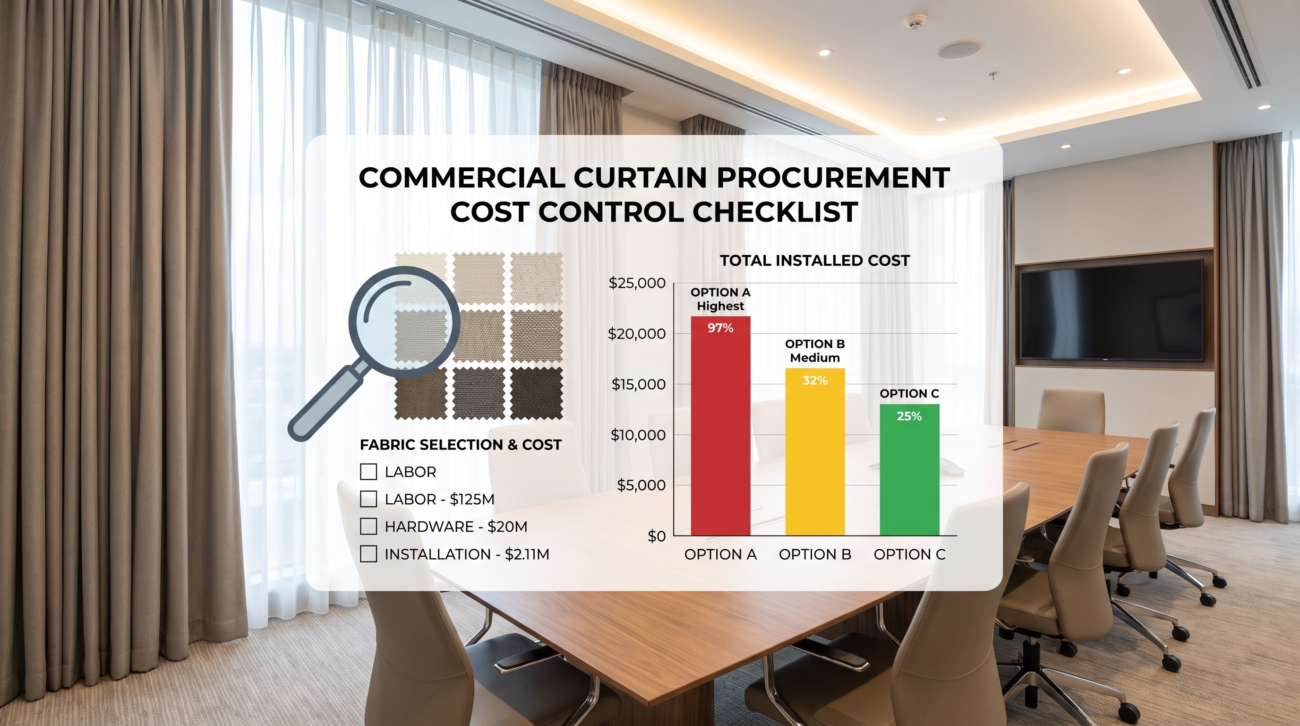
Use this checklist to audit your current blinds supplier before your next purchase order. If a supplier fails any of the seven red flags, request a corrective action plan or qualify a backup source immediately.
—
## 📚 Related Resources
– Commercial blinds supplier audit checklist — /guides/blinds-supplier-audit-checklist
– Fire-rated blinds certificate requirements — /guides/fire-rated-blinds-certificates
– One-stop blinds sourcing for contractors — /solutions/one-stop-blinds-sourcing
– How to calculate blinds total cost of ownership — /blog/blinds-tco-calculation
—
## ❓ Frequently Asked Questions
**Q: What do overseas engineering contractors check first when buying blinds?**
**A:** They verify compliance certificates, request production samples, and confirm stable delivery lead times before negotiating price. This sequence reduces rejected shipments and project delays.
**Q: Why is one-stop supply preferred in blinds procurement?**
**A:** One-stop supply reduces coordination costs, avoids mismatched components, and creates a single point of warranty support. It is especially valuable for projects using roller, zebra, and motorized blinds together.
**Q: How can contractors avoid MOQ traps with blinds suppliers?**
**A:** Request line-item quotations, confirm MOQ applies per SKU rather than per container, and ask for written confirmation of any custom color, motor voltage, or hardware fees.
**Q: What certificates matter most for commercial blinds?**
**A:** Fire-rated test reports, low-VOC or GREENGUARD certifications, ISO 9001 quality management, and regional compliance documents such as CE, UKCA, or AS/NZS matter most.
**Q: How often should contractors audit a long-term blinds supplier?**
**A:** Conduct an annual or project-based audit and revalidate production samples whenever fabric, motor, or hardware specifications change.