

Blog
Commercial Blind Spec Mistakes That Inflate Costs by 45% (And How to Balance Daylight, Privacy, and Shading)

Glare-driven cooling loads can inflate a commercial building’s energy spend by up to **45%**, and glare complaints are among the top reasons facilities teams re-spec window treatments within two years. Most failures trace back to one cause: **commercial blinds** specified for appearance instead of the daylight, privacy, and shading balance each space actually requires. This guide breaks down the seven costliest specification mistakes—plus the adjustable structures, fabric tiers, and supplier checks that eliminate them.
## Why the Daylight–Privacy–Shading Triangle Breaks Without a Real Spec
Daylight lowers artificial lighting loads and boosts occupant focus. Privacy protects confidential work and street-level security. Shading blocks glare and solar heat. The problem is that most fixed treatments force facilities to sacrifice one need to gain the other two. Blackout shades kill daylight; sheer shades expose interiors after dark.
Industry audits show balanced **commercial blinds** typically combine an adjustable slat or dual-fabric system so one window serves morning sun, midday glare, and evening privacy. That balance is not a premium feature—it is the baseline that separates re-spec jobs from one-and-done installs.
## 7 Commercial Blind Spec Mistakes That Inflate Costs by 45%
Each mistake below compounds energy waste, rework, or early replacement cost. Reliable manufacturers typically flag these during the quote stage; unreliable ones bury them until the chargeback arrives. Use this list as your audit before approving any **commercial blinds** order.
### 1. Specifying One Fabric Opacity for Every Facade
A south-facing facade takes direct solar gain, while a north facade receives diffuse light. One openness factor cannot serve both exposures. Industry audits show this single error accounts for up to **30%** of re-spec orders on **commercial window blinds**.
### 2. Choosing Fixed Slats Over Adjustable Light-Control Structures
Fixed verticals and fixed louvers cannot redirect glare as the sun moves. Adjustable tilt structures—usually **0° to 180°** on quality **commercial blinds**—let occupants switch between full view, angled daylight, and near-total privacy without changing hardware. If the spec does not name a tilt range, assume it is fixed and budget for glare complaints.
### 3. Ignoring Solar Heat Gain Coefficient (SHGC)
Fabric choice directly changes cooling load. A **5% openness** screen can cut SHGC by roughly **40%** compared with a **10% open weave**. Ask for SHGC and openness-factor data on every **commercial blinds** quote, not just color swatches.
### 4. Buying Pure Blackout Where Daylight Harvesting Would Pay
Blackout fabrics serve projection rooms and sleep labs. Everywhere else, a dim-out or dual-layer system preserves daylight harvesting while still blocking direct glare. Over-specifying **commercial blackout blinds** raises lighting energy use and occupant discomfort in offices, lobbies, and retail floors.
### 5. Skipping a Mock-Up Before the Bulk PO
Angles, fabric tension, and stack height change from sample card to installed run. Reliable manufacturers typically ship a **1-square-meter mock-up** for window tests before mass production. Skipping this step is a leading cause of **40%+ rework** on **commercial privacy blinds** and light-control systems.
### 6. Buying on Price and Ignoring Hidden MOQ Traps
Low unit prices often hide minimum order quantity fees, tooling charges, or freight penalties. To avoid costly chargebacks, lock total landed cost—packaging, split shipments, and defect allowances included—into the contract before signing. Ask the supplier to itemize every non-product line.
### 7. Overlooking Replacement-Part and Warranty Logic
Tilt gears, cord stops, and fabric panels fail on a different cycle than the rail. A five-year warranty that excludes tilt mechanisms is nearly useless. Demand a parts breakdown and a **10-year structural warranty** as standard on **commercial blinds** for high-traffic facilities.
## How Adjustable Angle Structures Deliver Privacy Without Blocking the View
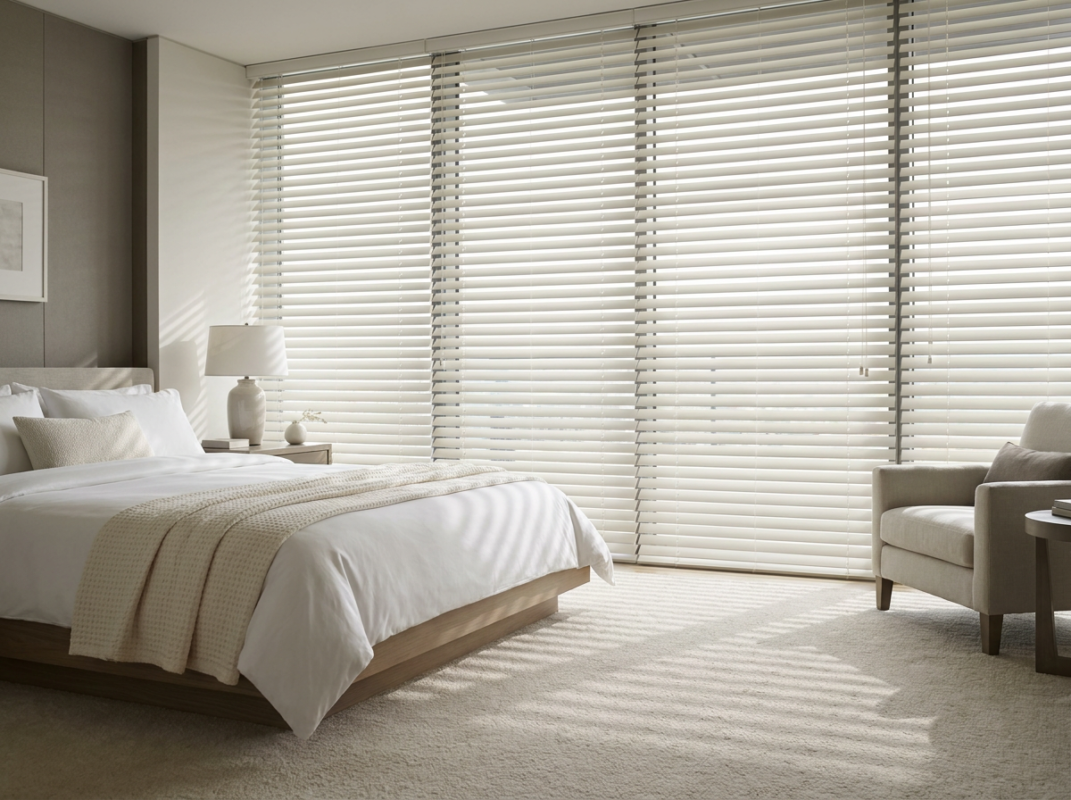
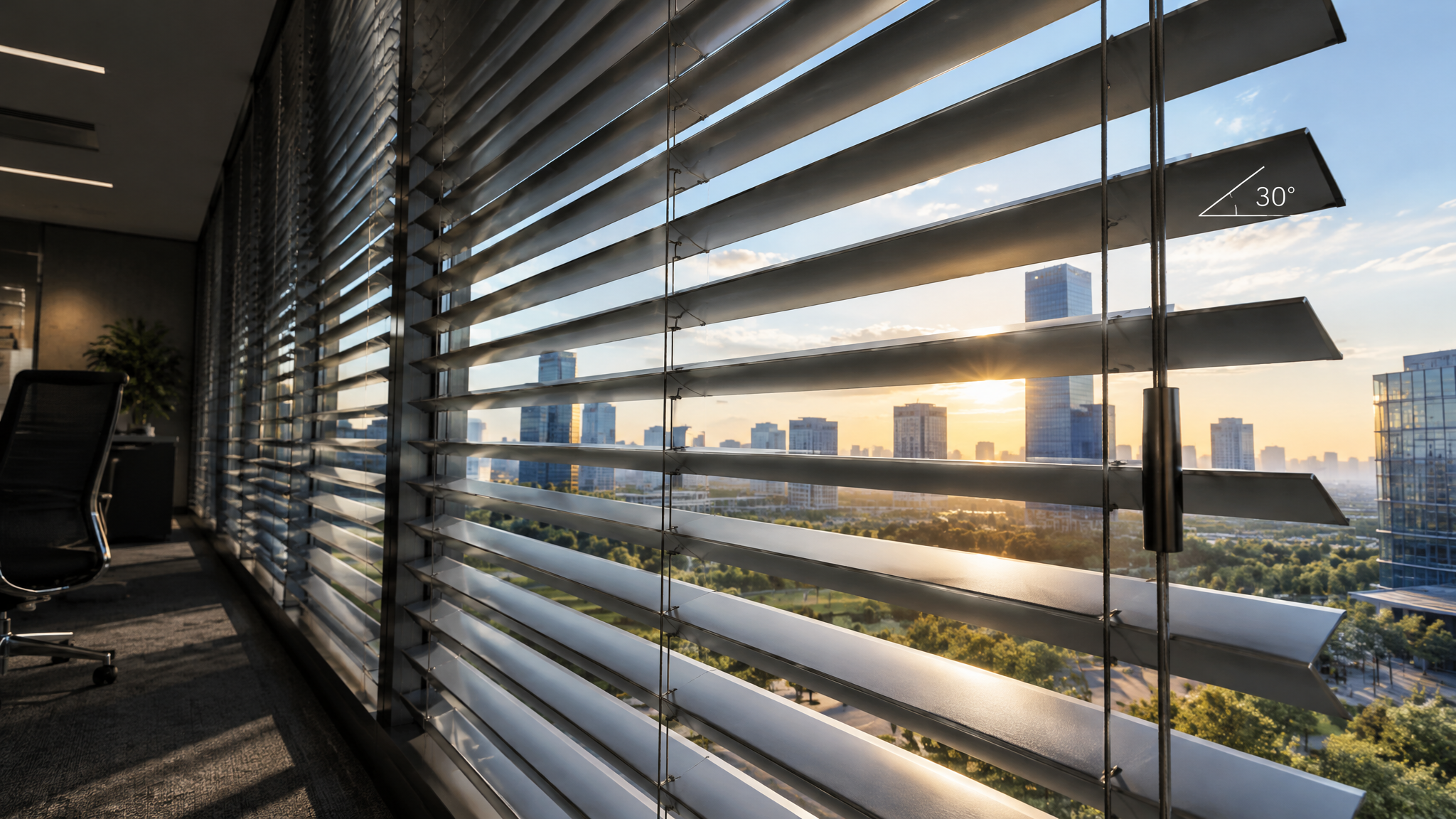
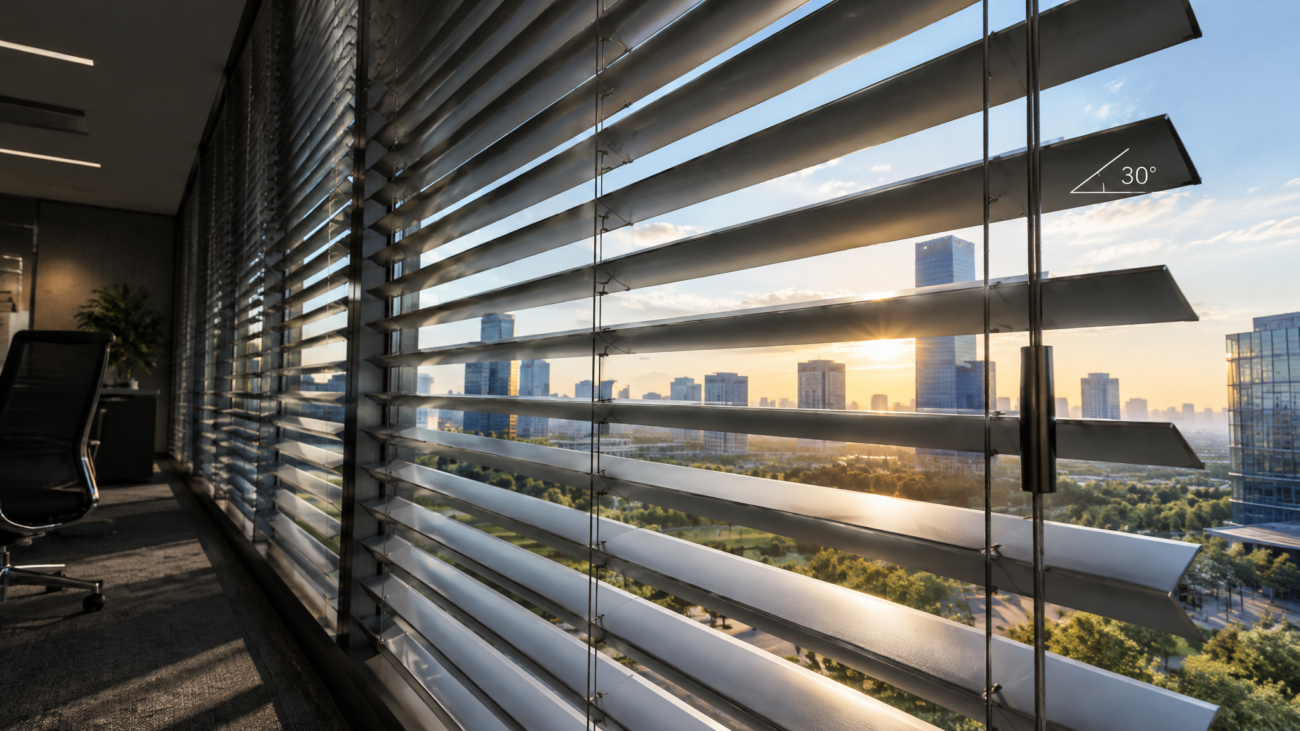
Modern **commercial blinds** solve the privacy paradox with angled slat geometry. Tilt slats upward to bounce daylight deep into the room while people outside see only the slat backs. Tilt them flat for a full outward view.
Close them for near-total blackout. One mechanism delivers three lighting modes from a single window—the exact daylight, privacy, and shading balance a static shade cannot match.
– **0°–15°**: upward daylight redirection, maximum transparency, minimal daytime privacy
– **30°–60°**: balanced glare cut with partial view and strong daytime privacy
– **75°–90°**: near-total closure for blackout and nighttime privacy
This adjustability is why facilities choose **commercial blinds** over fixed films in mixed-use spaces. It protects the view, not the glare.
## Multi-Fabric Tiers: Matching Openness Factor to Room Function
Openness factor is the percentage of open weave in a fabric. It drives the daylight, privacy, and shading trade-off for **commercial blinds** more than color or price. Industry audits show pairing **1%–3% open fabrics** on solar-loaded facades with **5%–10%** on shaded facades cuts glare complaints while keeping outward views.
– **1% openness**: maximum glare and UV cut, strong daytime privacy, limited view
– **3% openness**: strong solar cut with balanced view and privacy
– **5% openness**: daylight priority with moderate glare control
– **10% openness**: view-first spaces with minimal shading
– **0% blackout/dim-out**: media rooms, healthcare, and security zones
Specify at least two fabric tiers per project. A single tier is the fastest signal that the quote ignores facade orientation and room function—the two variables that decide whether **commercial blinds** actually balance light, privacy, and shading.
## Supplier Red Flags That Turn a Good Spec Into a Chargeback
Specs only matter if the factory honors them. Reliable manufacturers typically provide lab-tested SHGC and openness data, a physical mock-up, and a written parts warranty. Watch for these red flags before issuing a PO for **commercial blinds**:
– Quoting without fabric data sheets or fire-rating certificates
– Hiding MOQ and tooling fees until the final invoice
– No replacement-parts catalog or published lead-time commitment
– Pushing one fabric line regardless of facade orientation
Each flag increases the probability of post-install chargebacks. Require documentation on all four points in the quote itself—these checks apply to any **commercial blinds** supplier, from first sample to final install.
## Installation and Maintenance That Protect the Warranty
Even the best **commercial blinds** underperform when installed or maintained poorly. Follow these steps to protect warranty coverage and the daylight–privacy–shading balance over time.
### Clean Slats and Tracks Quarterly
Dust changes light reflectance and accelerates fabric wear. Wipe slats with a dry microfiber cloth and vacuum tracks every quarter in high-traffic offices.
### Calibrate Tilt Alignment After Month One
Settling shifts slat alignment. Re-calibrate the tilt mechanism **30 days after install** so all slats close evenly and privacy gaps disappear.
### Document UV Exposure and Fabric Tension at Each Service Check
Log tension and any color shift at **six-month intervals**. Early documentation turns warranty claims from disputes into approvals.
## Conclusion: Three Takeaways Before You Spec Commercial Blinds
First, angle-adjustable structures are the only way to serve daylight, privacy, and shading from one window—static fabric cannot. Second, openness factor and SHGC data decide energy outcomes more than color or price. Third, supplier checks around mock-ups, MOQs, and warranty parts prevent most of the **45%** cost bleed that appears after install.
Use this seven-point checklist to audit your current **commercial blinds** spec—or send it to your supplier before the next PO. If a quote cannot answer all seven points, walk away.
—
## 📚 Related Resources
1. Anchor: commercial blinds spec audit checklist → /commercial-blinds-spec-audit-checklist
2. Anchor: openness factor and SHGC fabric data sheets → /openness-factor-shgc-fabric-guide
3. Anchor: adjustable slat light-control structures → /adjustable-light-control-blinds
4. Anchor: supplier MOQ and landed cost checklist → /commercial-blinds-supplier-red-flags
—
## ❓ Frequently Asked Questions
**Q: What openness factor is best for commercial blinds that need both daylight and privacy?**
**A:** A **3% openness factor** usually delivers the strongest balance—strong solar cut, clear daytime privacy, and a useful outward view. Use 1% for glare-heavy facades and 5%–10% where daylight and views are the priority.
**Q: Can commercial blinds block glare without blocking the view?**
**A:** Yes. Adjustable slat structures tilt from **0° to 180°**, so occupants can redirect daylight upward, hold a partial view, or close the slats for near-total privacy—all from the same window.
**Q: What is the difference between blackout and dim-out commercial blinds?**
**A:** Blackout fabrics block nearly **100% of light**, ideal for media rooms and healthcare zones. Dim-out fabrics block roughly **85%–95%** while preserving some daylight, making them the better default for offices and retail.
**Q: How do I avoid hidden MOQ traps when ordering commercial blinds?**
**A:** Require an itemized quote covering tooling charges, freight, packaging, split shipments, and defect allowances. Lock total landed cost into the contract before signing.
**Q: How often should commercial blinds be maintained?**
**A:** Clean slats and tracks quarterly, re-calibrate tilt alignment **30 days after install**, and log fabric tension plus UV exposure every **six months** to keep warranty claims valid.